
Why You Feel Scattered All the Time (And How to Protect Your Attention)
If you’ve been feeling scattered, overstimulated, or like your focus is constantly slipping through your fingers — you’re not imagining it.
We’re living in a world that profits from distraction. Notifications, content, conversations, and demands are always pulling at our attention, often without us realizing just how much it’s costing us. And while we talk a lot about physical self-care and even mental health, there’s one piece of the puzzle that rarely gets named: attention hygiene.
In this episode of The Self Care Sisterhood Podcast, I’m breaking down why your attention feels so fragile right now — and how to care for it in a way that’s realistic, compassionate, and sustainable. This isn’t about productivity hacks, rigid rules, or disappearing from your life. It’s about learning how to steward your attention so you can feel more present, grounded, and aligned in your everyday life.
LET’S DIVE IN. 🖤
Okay… let’s talk about something that I think a lot of us are feeling but haven’t really had language for.
Have you ever had a moment where you sit down to do something meaningful — maybe it’s journaling, praying, working on a dream, or just being present — and somehow you end up distracted before you even realize it?
And then comes the frustration.
Why can’t I focus anymore?
Why do my days feel so full but so unfulfilling?
Why does everything feel scattered?
I want to say this clearly, right at the beginning:
Nothing is wrong with you.
Your attention isn’t broken.
Your discipline didn’t disappear.
Your motivation didn’t just vanish.
The environment changed.
And that’s why we need to talk about attention hygiene.
WHAT ATTENTION HYGIENE ACTUALLY IS
So I’m gonna go out on limb and guess that as grown ass women, we understand physical hygiene. You brush your teeth, you wash your hands — not because you feel like it, but because it’s how you care for your body and stay healthy.
We’re starting to understand mental hygiene too — and it’s something we talk a lot about in this space — noticing our thoughts, practicing healthier self-talk, tending to our inner world. But I’m really excited to bring a new outlook on hygiene into our conversations this year. We’ve been dabbling in it but not actually naming it, so let’s give it a name:
Attention hygiene is how we care for where our attention goes.
Because what you give your attention to is what shapes your nervous system, your peace, your creativity, your faith, and your sense of direction.
And right now?
Your attention is under constant pressure.
Not because you’re weak — but because it’s valuable.
WHY ATTENTION HYGIENE NEEDS TO EXIST AS A CONVERSATION NOW
Attention hygiene wasn’t something we really needed to talk about thirty years ago. Or shoot…even 10-15 years ago. The first i-Phone came out in 2007 so it hasn’t even been 20 years yet of smart phones in our hands. And in the last decade there have been so many new apps and features and upgrades to the technology. But not too long ago…
There weren’t endless notifications pulling us out of the present moment.
There wasn’t an economy built on keeping us just distracted enough to keep scrolling.
There weren’t algorithms competing for our focus, our emotions, and our nervous systems.
Today, attention is monetized.
Distraction is engineered.
So if you’ve been feeling scattered, overstimulated, or like you can’t focus the way you used to — that’s not a character flaw.
You’re not undisciplined.
You’re overwhelmed.
And overwhelm doesn’t make us better people — it fragments us.
THE WHEAT AND THE WEEDS (THIS REFRAME CHANGES EVERYTHING)
I heard this in church recently and it stayed with me so much that I knew I needed to share it here in this space.
In Matthew 13, Jesus tells a parable about a farmer who plants good seed in his field — wheat. But while everyone is sleeping, an enemy comes along and plants weeds among the wheat.
As the plants grow, the workers notice the weeds and ask the farmer if they should pull them up. And this part is important: the farmer says no — because pulling up the weeds would also uproot the wheat. So instead, he tells them to let both grow together until the harvest. Weeds growing among wheat.
Here’s why I love this story.
The enemy couldn’t destroy the good seed that was planted — so instead, he tried to distract it. He planted weeds right alongside it.
And that’s what distraction looks like in our lives. Weeds are growing right alongside your beautiful, precious wheat.
The weeds aren’t always obvious or evil. They grow right next to the good things. They look similar. They compete for attention, nutrients, and space — and if we’re not paying attention, they slowly choke what’s actually meant to grow.
This parable isn’t about removing all the distractions that come up in living a purpose driven life. It’s about discernment. About noticing what’s growing next to your purpose and asking whether it’s nourishing you or draining you. And when it comes to attention hygiene, this matters — because most of the things stealing our focus aren’t bad things. They’re just loud things. Constant things. Things that live right alongside our good seed. And even if you don’t come from a faith background, the idea still holds:
not everything competing for your attention deserves your energy — especially when you’re trying to grow something meaningful.
WHAT ATTENTION HYGIENE IS NOT
Before we get practical, I want to be really clear about what this is not.
This is not me telling you to throw your phone in a lake and go live an Amish life. That’s not realistic for most of us — and it’s not the goal.
Attention hygiene is not:
productivity hacks —we’re not trying to squeeze more out of you or turning your attention into something you need to optimize
extreme digital detoxes — which looks like disappearing for weeks and then snapping right back into old patterns
rigid rules — because truthfully, this never works — life changes, seasons change, and shame isn’t a strategy
forcing focus — we’re not white-knuckling concentration or bullying yourself into being disciplined bc that’s not sustainable
or becoming unavailable to everyone in your life — this isn’t about isolation or checking out from relationships
All of these are forced control. Instead I want you to think of attention hygiene as being a good steward — of your time, your energy, and your attention.
And when it comes to your attention, that means learning how to protect this really valuable resource without shaming yourself for living in the world we live in — because tech isn’t going anywhere. We have to learn how to live with it and put it in its proper place.
Your phone shouldn’t own you. You should have rhythms, boundaries, and practices that honor and nourish your attention instead of constantly zapping it.
This is about noticing where your energy is going…
what’s nourishing you…
and what’s quietly draining you.
PRACTICAL WAYS TO PRACTICE ATTENTION HYGIENE
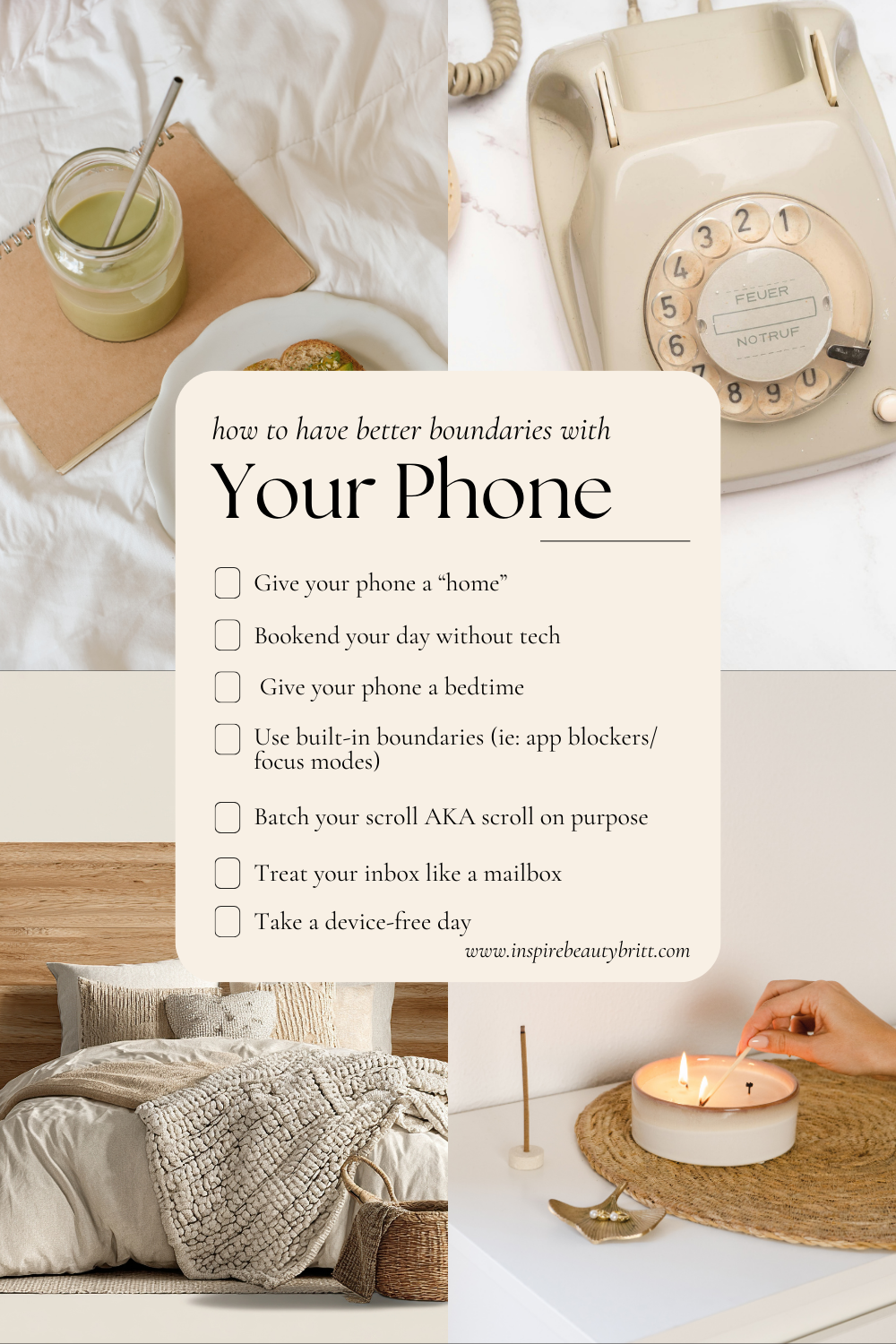
(the stuff that actually gives you your life back)
1) Give your phone a “home” (single-use spaces)
This one is so simple it almost feels too easy… but it works. Your phone doesn’t need to be with you everywhere you go in your own house. It needs a place.
So instead of your phone living in your hand or in your pocket all day…
it lives on the counter.
Or on the charger.
Or in your office.
Or in a drawer.
And you go to it on purpose.
Because when your phone is always on you… your attention is always available to be hijacked.
Your phone is a tool. Not a body part.
2) Bookend your day without tech
If you want your attention back, start with the first and last 30 minutes of your day.
Not because you’re trying to be “better.”
But because the way you start your day becomes the way you live your day.
So instead of waking up and immediately downloading the world into your brain…you wake up and stay in your life.
This can look like:
coffee + quiet
a few pages of a book
a quick stretch
journaling
sitting outside for 5 minutes
literally just breathing like a normal person 😂
And at night? Same thing.
You’re not ending your day in someone else’s highlight reel or the downfall of humanity.
You’re ending it in your own peace.
3) Give your phone a bedtime
I swear this is one of the most underrated boundaries.
Your phone doesn’t need unlimited access to you.
And you don’t need unlimited access to everyone else.
So you choose a time — 8pm, 9pm, whatever works — and your phone goes to bed.
It’s a rhythm that tells your nervous system:
“We’re safe. We’re done. We can exhale now.”
4) Use built-in boundaries (Brick, app blockers, focus modes)
Some of us need a little help.
Because our brains are smart… but the apps are smarter. 😅
So if you’re the kind of person who says “I’ll just have discipline” and then somehow you wake up in a TikTok wormhole…
This is your permission slip to use tools.
Brick.
App limits.
Downtime settings.
Focus mode.
Not as punishment.
As protection.
Because the goal isn’t “be stronger.”
The goal is: make it easier to stay aligned.
5) Batch your scroll (scroll on purpose, not by accident)
This is my favorite middle ground because I’m not anti-fun.
I love funny reels.
I love sending them to my husband and my best friends.
I love research.
I love inspiration.
But what I don’t love is the way “a quick scroll” turns into 47 minutes and a headache.
So instead of scrolling all day in micro-moments…
I batch it.
Like:
“I’m going to scroll from 7:30 to 8:00.”
And when the time is up… I’m done.
Scrolling is not bad.
Unintentional scrolling is what drains you.
6) Treat your inbox like a mailbox
This one will change people’s lives.
Your inbox is not an emergency room.
It’s a mailbox.
You don’t need to check it every 12 minutes like you’re waiting on a life alert.
So I treat it like:
once in the morning
once in the evening
And that’s it.
Because every time you check your inbox, you’re basically saying:
“Interrupt me. Redirect me. Pull me out of my life.”
And we’re not doing that anymore. Imagine if you walked to your mailbox as many times as you check your phones inboxes. People would think you’re weird. But yet it’s normal to do this with our phones?! No. Let’s be different.
💫 BONUS: A device-free day (or half day)
This is where your attention starts to feel like yours again.
A full day is amazing… but even a half day counts.
No scrolling.
No “just checking.”
No background noise.
Instead:
a walk with no input
yoga
errands with the radio off
sitting outside
cooking with music (not content)
being bored on purpose
Because boredom isn’t a problem.
It’s the doorway back to creativity.
Before we wrap up, I just want to leave you with this:
What you give your attention to shapes who you become.
Because your attention isn’t neutral.
It’s not just something you “spend” throughout the day.
It’s something you plant.
And whatever you keep watering… grows.
So if your attention is constantly being pulled into noise, comparison, urgency, and other people’s opinions… you’re going to feel scattered. You’re going to feel behind. You’re going to feel like you can’t hear yourself anymore.
But when you start protecting your attention — even in small ways — you start coming home to yourself.
You start hearing your own thoughts again.
You start feeling your own emotions again.
You start noticing what you actually need… instead of just reacting to what everyone else wants from you.
And listen… this isn’t about being perfect.
This isn’t about never scrolling again or becoming some unplugged minimalist who lives off the grid.
This is about stewardship.
It’s about remembering that your attention is a precious resource — and you get to decide where it goes.
So here’s my encouragement for you this week: Test out one practice. Just one.
Give your phone a home.
Bookend your day without tech.
Batch your scroll.
Create a bedtime for your phone.
Use a tool like Brick.
Treat your inbox like a mailbox.
Just choose one thing… and watch what starts to shift. The goal here is presence. And you deserve a life you’re actually in.
I love you, I’m cheering you on, and I’ll talk to you next week. 🤍

PS…This website includes affiliate links. If you click and purchase, I may receive a small commission at no extra cost to you. I only recommend products + tools that I have personally reviewed, love, and/or use. You can read the full statement HERE.
